The vehicle routing problem is a generalization of the traveling salesman problem, but is a special case
of the pickup and delivery problems. In this problem,
we are given  vehicles and a complete graph
  , and the objective is to find a separate tour for
each vehicle with
respect to minimizing or maximizing some objective function, such as the total cost of the tours.
This problem has direct relevance to the industry-related research we are pursuing.
The vehicle routing problem has numerous variations, and has been extensively investigated by many researchers.
Various
techniques, such as linear programming, local search, and even clustering, have been applied or
invented to solve these problems. However, as a well recognized method of dealing with
, and the objective is to find a separate tour for
each vehicle with
respect to minimizing or maximizing some objective function, such as the total cost of the tours.
This problem has direct relevance to the industry-related research we are pursuing.
The vehicle routing problem has numerous variations, and has been extensively investigated by many researchers.
Various
techniques, such as linear programming, local search, and even clustering, have been applied or
invented to solve these problems. However, as a well recognized method of dealing with  -
- problems, good approximation algorithms have not been well explored for this problem.
An extensive coverage of VRP can be found in [52]
problems, good approximation algorithms have not been well explored for this problem.
An extensive coverage of VRP can be found in [52]
Techniques used
We have made significant progress in the design of approximation algorithms for various forms of vehicle routing problems.
For two models of CVRPPD, namely the
Dial-a-Ride problem and the  -delivery TSP on paths and trees, we propose a strategy called
the come back rule. Our algorithms are all based on this strategy.
Under the come back rule[34], the vehicle would not be allowed to cross a
particular edge
-delivery TSP on paths and trees, we propose a strategy called
the come back rule. Our algorithms are all based on this strategy.
Under the come back rule[34], the vehicle would not be allowed to cross a
particular edge  if some condition is met. Such a condition varies for different problems. The existing method for
these problems, follows the strategy (first introduced in [17]) that, the
vehicle would continue to pick up (deliver) items if possible. The come back rule differs
from this method in that, under the come back rule the vehicle may not deliver its load
immediately, but come back and pick up more items for a better schedule. As a consequence, on its
way back, the vehicle may traverse several edges without servicing any jobs, even when it is carrying
a large load. This is somewhat contrary to our intuition.
For two problems in the category of MVRP,
namely MDCVRP and MVSP in trees, we propose a new way of using dynamic programming to design
constant-factor approximation algorithms. Under this approach, dynamic programming is used to
decompose a problem instance
if some condition is met. Such a condition varies for different problems. The existing method for
these problems, follows the strategy (first introduced in [17]) that, the
vehicle would continue to pick up (deliver) items if possible. The come back rule differs
from this method in that, under the come back rule the vehicle may not deliver its load
immediately, but come back and pick up more items for a better schedule. As a consequence, on its
way back, the vehicle may traverse several edges without servicing any jobs, even when it is carrying
a large load. This is somewhat contrary to our intuition.
For two problems in the category of MVRP,
namely MDCVRP and MVSP in trees, we propose a new way of using dynamic programming to design
constant-factor approximation algorithms. Under this approach, dynamic programming is used to
decompose a problem instance  indirectly to a set of disjoint subproblems.
As it is not possible to try all the configurations of the subproblems by directly obtaining
solutions for
, we instead find another problem
indirectly to a set of disjoint subproblems.
As it is not possible to try all the configurations of the subproblems by directly obtaining
solutions for
, we instead find another problem  and locate a set
  of disjoint
subproblems by using dynamic programming to solve
in the underlying graph.
We then work on approximation algorithms for the subproblems in
. It is guaranteed that a
good approximation for
can be obtained by approximating these subproblems well. To achieve this, we
choose
in a way such that
satisfies some property inherent in the optimal
solution of
.
is much simpler and can be solved well by using dynamic programming in the
underlying tree. More importantly, as
is a relaxation of
, after solving
we not only find a
lower bound on
of disjoint
subproblems by using dynamic programming to solve
in the underlying graph.
We then work on approximation algorithms for the subproblems in
. It is guaranteed that a
good approximation for
can be obtained by approximating these subproblems well. To achieve this, we
choose
in a way such that
satisfies some property inherent in the optimal
solution of
.
is much simpler and can be solved well by using dynamic programming in the
underlying tree. More importantly, as
is a relaxation of
, after solving
we not only find a
lower bound on  , but also obtain a set of subproblems with good properties which can be used to
approximate
. This method is used to give a 2-approximation and a 3-approximation for MDCVRP and
MVSP in trees, respectively. No constant-ratio approximation algorithms are previously known for
these two problems.
, but also obtain a set of subproblems with good properties which can be used to
approximate
. This method is used to give a 2-approximation and a 3-approximation for MDCVRP and
MVSP in trees, respectively. No constant-ratio approximation algorithms are previously known for
these two problems.
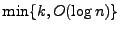
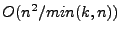
The results are summarized in Table 1.
|
 time, exact


 time, exact